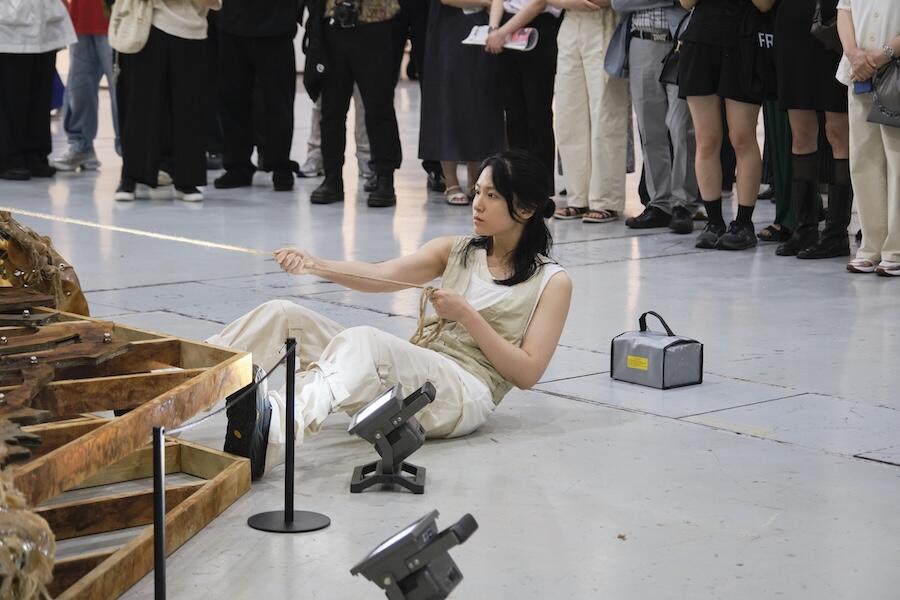
Frieze Seoul 2026 opened at COEX in Gangnam with two simultaneous pictures: crowded aisles and a series of important sales, but also collectors showing greater caution at the highest price levels. This is the fair’s fifth edition, presented with Kiaf SEOUL, and it increasingly resembles a platform built around Korea’s own ecosystem rather than an Asian outpost of Frieze. More than 70 per cent of exhibitors are based in the Asia-Pacific region, while over 50 participating galleries operate permanent spaces in Seoul.
The numbers and a new Asian balance
The fair brings together more than 125 galleries from 30 countries. Alongside major international dealers—including Gagosian, David Zwirner, Pace, Hauser & Wirth, White Cube and Thaddaeus Ropac—Korean and Asian galleries have structural weight. Focus brings together 16 emerging galleries founded in or after 2014, each presenting a solo project. The significant point is not merely numerical: Frieze is attempting to shift attention away from the market’s usual capitals towards underrepresented practices and art-historical lineages.
Sales: Ghenie leads, but the market remains selective
The leading reported opening-day sale was Adrian Ghenie’s Figure with Funerary Stele (2026), sold by Thaddaeus Ropac for €1.1 million, approximately $1.28 million. The gallery also sold Antony Gormley’s HOLD (2024) for £750,000, alongside works by David Salle, Martha Jungwirth and Alex Katz. White Cube reported a Gerhard Richter at €625,000 and a late Ecriture painting by Park Seo-bo at $300,000. Hauser & Wirth reported sales between $185,000 and $600,000 for works by Louise Bourgeois, Lorna Simpson and Jenny Holzer.
This was not, however, indiscriminate buying. The Korea Herald described steady movement in five- and six-figure works, while several multimillion-dollar pieces remained available at the end of the first day, including a $3.5 million George Condo. These figures are dealer reports rather than publicly verifiable transaction records; they should be read as indicators of commercial mood, not as a final balance sheet for the fair.
“Large crowds and genuine buying, but more measured cheques: Seoul is growing without disguising the caution of the global market.”
What is new: Spotlight and Material Practice
Spotlight makes its Seoul debut under curator Wonseok Koh, foregrounding 20th-century artists left outside dominant canons. It is a significant move for a market seeking historical depth beyond blue-chip names. Material Practice connects contemporary art, design and craft knowledge: ceramics, lacquer, textiles, glass and inherited techniques are treated not as decoration but as languages capable of intervening in the present. Participants include Art Space 3, Arumjigi Foundation, Charles Burnand Gallery, Gallery LNL, Marta, Soluna Fine Art and Waterfall Gallery.
The 2026 prizes
Tokyo gallery Taro Nasu received the Frieze Seoul Stand Prize for a cohesive, experimental presentation including Marcel Broodthaers, Ryan Gander, Ryoji Ikeda and Mika Tajima. The Focus Stand Prize went to Seoul’s Pipe Gallery for Seungean Cha’s solo project 0101 Weaving: Recovering Materiality in the Digital Age, which connects abstraction, weaving and a critique of digital dematerialisation. The 2026 Frieze Seoul Artist Award was given to Yagwang, the collective formed by In Jeon and Terri Kim.
Artists to follow inside and beyond the fair
Among the most anticipated presentations are Do Ho Suh, also the subject of a major survey at the National Museum of Modern and Contemporary Art; Lee Bae, alongside his Museum SAN exhibition; Koo Jeong A, ahead of a solo exhibition at Leeum Museum; and Yoo Youngkuk, whose retrospective is at the Seoul Museum of Art. International highlights include projects by Damien Hirst, Yayoi Kusama, Glenn Ligon, James Turrell, Olafur Eliasson and Georg Baselitz. The week’s real value lies in the continuity between fair stands, museums, foundations and galleries across the city.
Performance, film and a citywide treasure hunt
The programme extends beyond the halls through Ryan Gander’s The Find Seoul, which hides 16,000 collectible artworks across the city. Frieze Film collaborates with the Busan Biennale, while LIVE, talks with Kiaf and KAMS, Frieze Music and projects centred on the moon jar expand the fair beyond its commercial format. Neighbourhood Nights brought late openings, performances and events to Euljiro, Hannam, Cheongdam and Samcheong from 31 August to 3 September.
Practical information
Frieze Seoul occupies Halls C and D on Level 3 of COEX, 513 Yeongdong-daero, Gangnam-gu. On Thursday 3 September it is open to the public from 15:00 to 19:00; on Friday 4 and Saturday 5 September from 11:00 to 19:00, with last admission at 18:30. Kiaf SEOUL occupies Halls A and B on Level 1 and continues until 6 September. Frieze tickets provide access to both fairs according to the purchased ticket category. The organisers recommend the North or West Gate; nearby stations are Samseong, Bongeunsa and Cheongdam.
The Note’s provisional verdict
Frieze Seoul 2026 appears strongest when it stops imitating Western fairs and uses Seoul as a lens in its own right: its advantages are Asian participation, renewed attention to history and material practice, and a city mobilised around culture. The limitation is commercial: traffic is high, but demand appears concentrated on established names and more controlled price bands. A proper assessment will only be possible after the fair closes, separating media impact from completed sales.
Sources and updates
Updated 3 September 2026. Official exhibitor, programme, opening-hour and prize information was checked against Frieze and Kiaf SEOUL. Commercial information comes from Artsy and the Korea Herald and is identified as sales reported by galleries. This article will be updated with a final assessment after the fair closes.
Frieze · Galleries · Frieze · Programme · Frieze · Visitor information · Artsy · Opening sales · Korea Herald · Kiaf SEOUL
Lead image: Frieze · WeCap Studio / Courtesy Frieze.